Apollo 11: the landing, replayed
The last 13 minutes of Apollo 11's descent to the Moon in 3D, on the real timeline, with Mission Control's own audio and the Luminary 099 code that was running in the guidance computer.
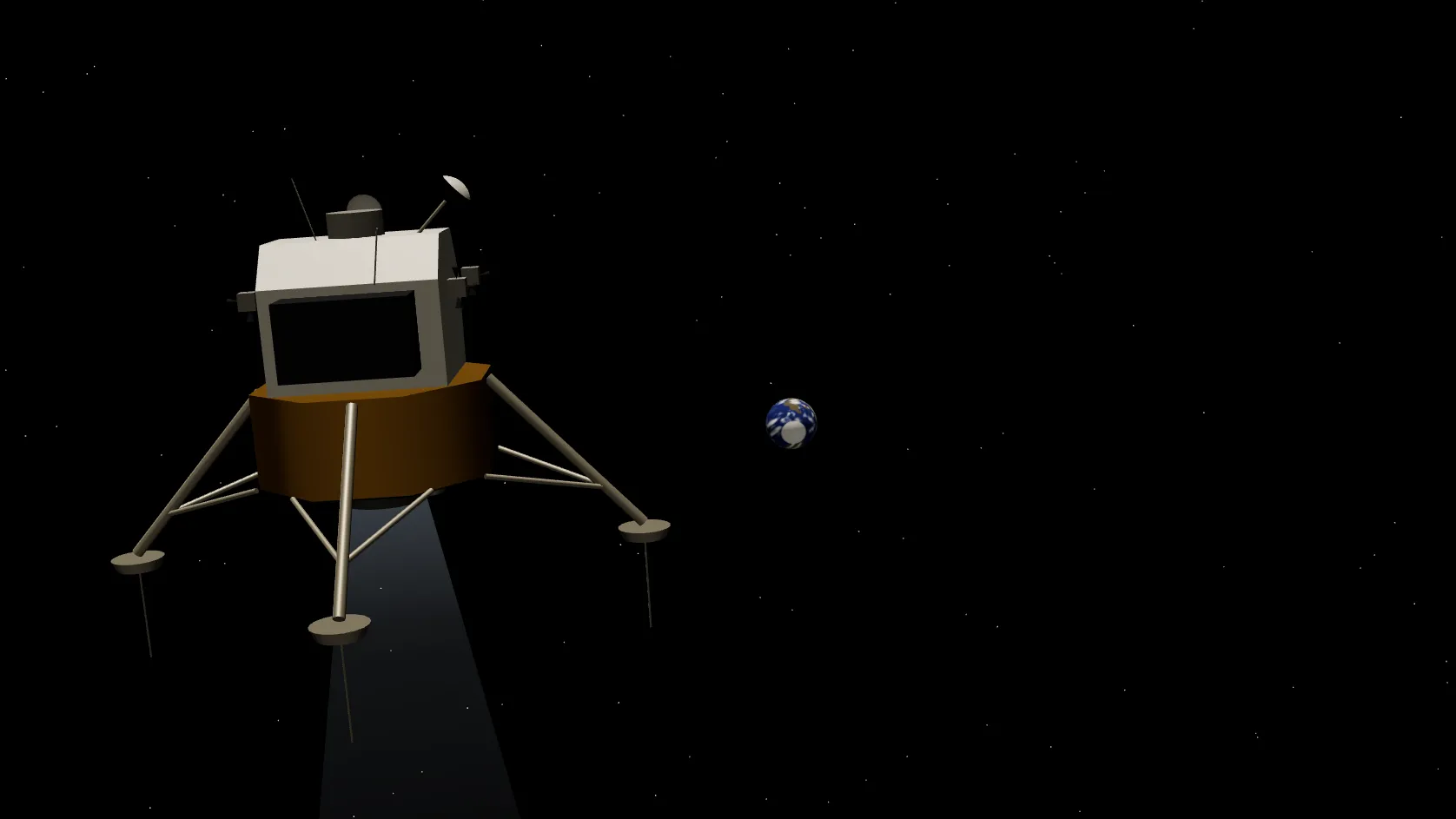
3D in your browser. The sound is Mission Control's own tapes.
How to use it
Press play and it runs in real time, from just before powered descent to a minute after touchdown: about 12½ minutes from ignition to the surface at 1×, or faster at 4× and 16×. Drag the altitude timeline or use the buttons (Ignition, 1202 alarm, P64, P66, Touchdown) to jump. The camera follows the descent on its own (Auto), or you can ride behind the LM (Chase), look out of Armstrong’s window, watch from the surface, or orbit freely.
Turn on the sound to hear the Mission Control tapes in sync with the picture. There are three loops: Air-to-ground (CAPCOM Charlie Duke and the crew), Flight (Gene Kranz and the room) and GUIDO, the guidance officer’s loop, where the calls on the 1202 alarms were made.
Beside the view: the DSKY as the crew saw it, with Aldrin’s keystrokes; the routine of the guidance computer behind each moment, with a moving “program counter” through the real source; the 2-second guidance loop and an estimate of the computer’s load; the voice transcript; and the switches and events in the cockpit.
A link can open a moment: the first 1202 alarm, or the last seconds before touchdown, out of the window.
What’s real and what’s reconstructed
It’s a reconstruction, not an emulation. The voice, alarms and callouts are timed from the Apollo Lunar Surface Journal transcript. Altitude, speed and pitch are interpolated between the numbers the crew read out and those in the Mission Report. The DSKY shows the nouns Luminary 099 defines, with values from that trajectory; the keystrokes between the transcript’s lines (V05N09, RSET, V57) are inferred from it.
The code is verbatim from the Luminary 099 listing, with its line numbers. Which routine is “running” is a guide to the 2-second guidance pass, not an instruction trace. The terrain is procedural except for the shape of the scene near the landing site: West crater, its boulder field, and Little West.
The sound is Mission Control’s own: the 30-track recorder, tape T884b, digitised by UT Dallas for NASA and the NSF. The tape runs on mission time; its speech lines up with the transcript to within about a second.
Sources
- Apollo Lunar Surface Journal: the landing transcript and commentary.
- Apollo 11 in Real Time: the Mission Control audio, digitised by UT Dallas (NASA, public domain).
- chrislgarry/Apollo-11: the Luminary 099 source for the lunar module’s computer.
- Virtual AGC: the AGC documentation and the scanned listings behind that source.
- The Apollo 11 Mission Report (NASA MSC-00171) for the trajectory and event times.