What businesses actually hire people to build
Most indie hackers start with an idea and then go looking for people who want it. I wanted to try it the other way round: find out what businesses already pay for, and only then think about what to build.
So I scraped job posts from freelance marketplaces, more than 20,000 of them from 2026, where a business describes something it wants built, automated or collected. Then I had AI read every post in full and sort it by what was asked for, who asked and why.
A job post is a good signal. Someone wrote down a problem and is ready to pay to make it go away. Most waitlists can’t say that.
Here is what keeps coming up.
1. Lead follow-up for service businesses
A plumber misses a call because they’re on a job, and the customer calls the next plumber. So the requests are simple: text back missed calls, reply to new web leads within minutes, book the job, send a reminder, ask for a review afterwards.
AI made this cheap enough for a three-person company. But the posts don’t ask for an “AI receptionist”. They ask to stop losing jobs.
Most of these setups are bought by marketing agencies, who install the same thing for dozens of local clients. More on that below.
2. Connecting tools they already use
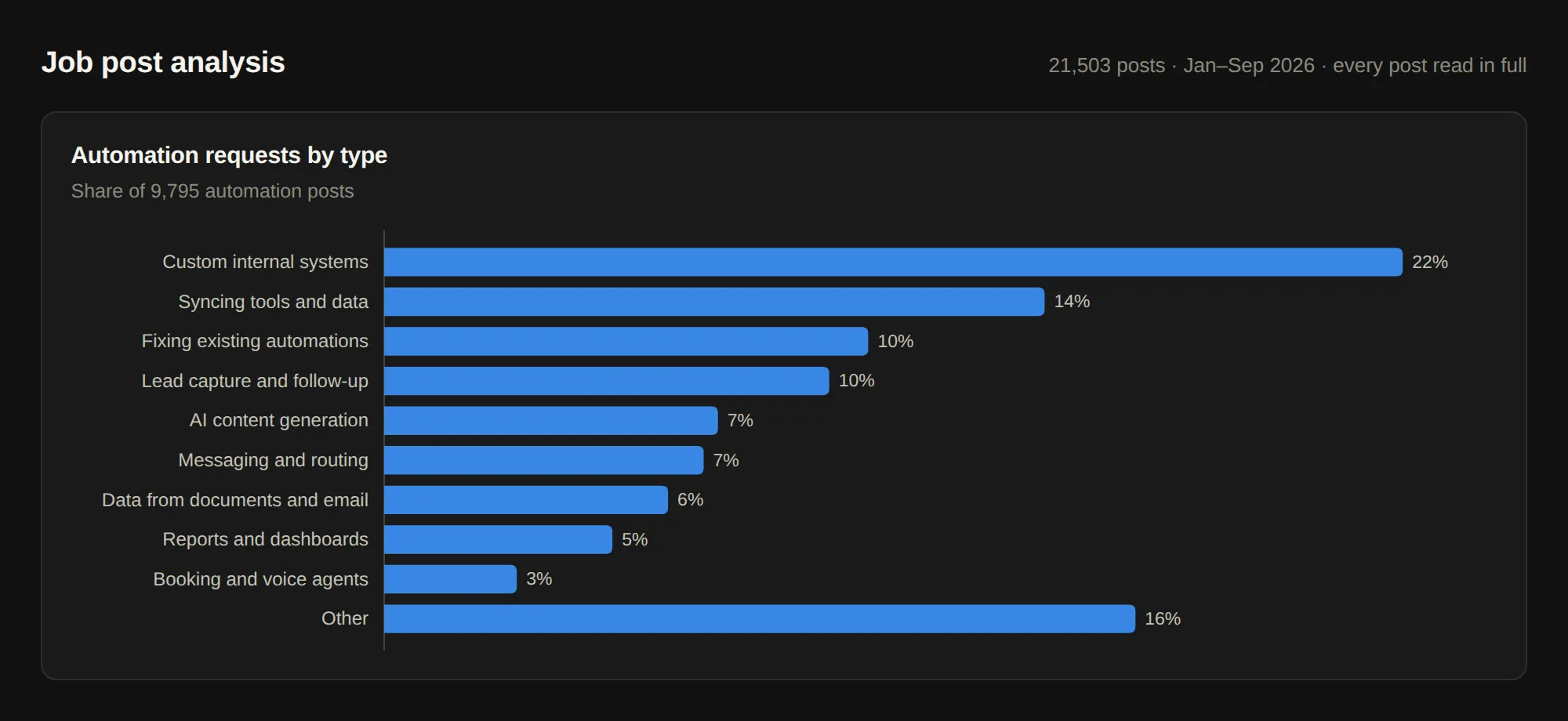
Google Sheets to QuickBooks. Website forms to the CRM. CRM to invoices. Each job is small, but they come up every day. It’s the second-biggest kind of automation request, after custom internal tools built for one company.
Very few posts ask to replace a tool. The business has a handful of apps that work fine on their own, and wants data to move between them without someone copying it by hand.
3. Getting data out of documents
Invoices, receipts, PDFs and emails turned into rows in a spreadsheet or entries in the accounting system. The buyers are mostly finance and back-office people.
Budgets here are better than for marketing work. The alternative is a person typing it all in, and that person costs money every month.
4. Lists of local businesses
Contractors, clinics, restaurants, salons. The big B2B data tools work well for tech companies and badly for local ones. Finding heads of sales at software companies is easy, because they’re all on LinkedIn. Finding independent HVAC companies in one city is much harder. Many of these owners aren’t on LinkedIn at all.
So agencies and software companies that sell to local businesses keep paying people to build these lists by hand.
The buyers have become picky too. Most set a quality bar up front: verified emails, a bounce limit, direct phone numbers. Many start with a small paid test, often because a list they bought before was mostly useless.
5. Public records as a weekly feed
Foreclosures, tax liens, probate cases, new business licences, building permits, tenders. All public, most updated every week, each on its own clunky government website.
Real estate investors, contractors, suppliers and lenders want them every week, not once, and they often complain that the big tools are out of date. Data that changes every week can be sold as a subscription. Data that doesn’t change is a one-time sale.
6. Fixing automations
About 1 in 10 automation requests is a repair. “My Zap stopped working.” “The n8n flow broke and the developer is gone.” “This script ran for a year and then stopped.”
Lots of people sell automation builds. Very few sell upkeep: a monthly price per workflow, monitoring, and notes so the next person can fix it. The more automations businesses get built, the more of these posts there will be.
7. Excel and Google Sheets work
Excel and VBA come up about as often as n8n, and more often than Zapier or Make. That stayed flat all year.
The people asking are accountants, ops managers, property managers, warehouse leads. They don’t want to move to a new tool. They want the sheet to pull data in, send the invoices or build the weekly report on its own. If you build for them, build inside the spreadsheet.
8. AI content pipelines
Blog posts, social posts, product descriptions and short videos, made on a schedule. There are plenty of these requests, but it’s also where most builders already are, so the competition is heaviest here.
What I take from it
The buyer is often an agency, not the business owner. Plumbers, dentists and gym owners rarely shop for software. The marketing agency with 40 dental clients does. Many posts that look like they come from a small business are from an agency that will reuse the work for many clients. That changes what you build (something reusable) and who you sell to (a few thousand agencies, not millions of owners).
Build inside what they already use. The sheet, the accounting system, the CRM they already pay for. A new app means switching, and most of these businesses won’t switch.
Templates solve fewer problems than they seem. Fewer than 1 in 5 automation requests could be fully solved by a ready-made template, and more than a third couldn’t use one at all. The client’s CRM, their spreadsheet layout and their industry rules all need custom work. A setup package for one industry fits better: mostly reused, partly configured, sold at a fixed price.
Repeat work beats one-off work. A weekly data feed, a monthly upkeep fee, a list that has to stay fresh. Those are the requests where the same client comes back.
How to look for demand yourself
- Read what people already pay for: job posts, freelance requests, tenders.
- Count. One request is a hint. The same request from 50 different businesses is a market.
- Look for repeat orders. Weekly beats once.
- Check whether the data or workflow comes from public sources, so you can build it before anyone orders.
- Check the existing tools. If people complain they’re stale or wrong, that’s an opening.
- Start narrow: one industry, one region.
Reading thousands of posts used to be the hard part. Now AI can read every one of them in full overnight, so there’s little reason to build first and look for buyers later.